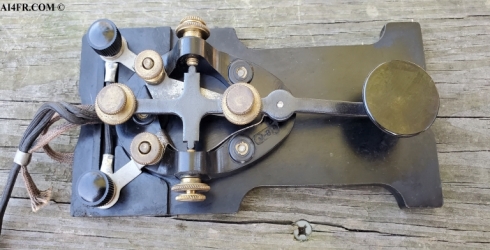
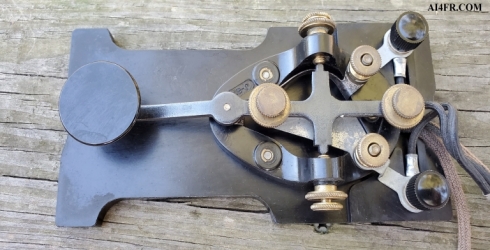
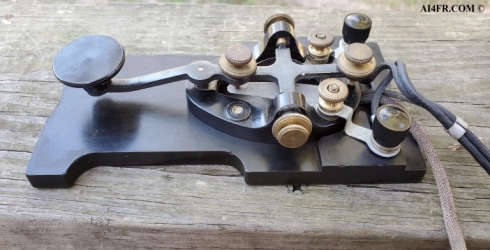
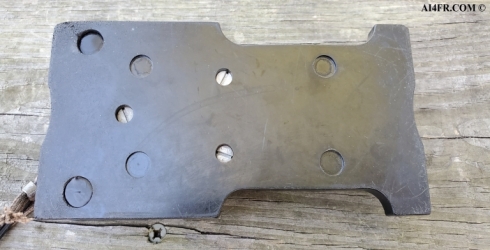
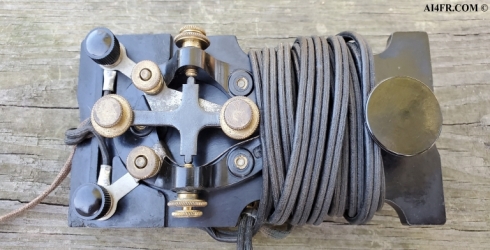
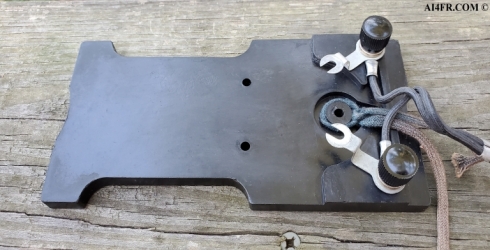
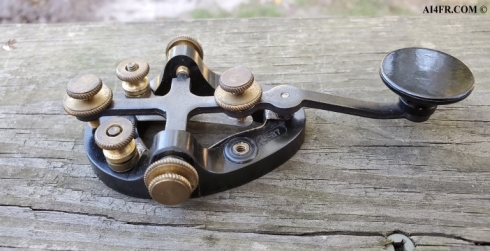
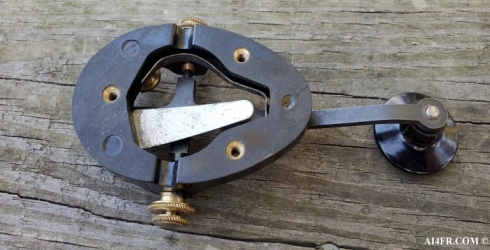
The good ole J-37(Signal Corps. stock number 3Z3437) key served with the U.S. military during WWII, the Korean War, and through-out the Vietnam era. The J-37 key was the real workhorse during those years and carried the bulk of the action. The J-37 key has been built into many numerous and different configurations with the addition of different bases. According toThe Vail Correspondent #5 January 1993: The J-37 seen here is attached to its own unmarked base(Signal Corps. stock number 3Z3437-1). This base is cut away on the sides and shaped like the letter "I". It originally came with the AN/GSC-TI portable code training set which had 10 keys each in their own slot. Each key came with a 10 foot cord which was wrapped around the base(the reason for the cut away sides on the base) for storage. These keys were made by McElroy. To view a J-37 key configured as a J-45(leg band assembly) please visit HERE . To view a J-37 key configured as a J-47 please visit HERE . Where does the J-37 name come from? Well, it was the U. S. Signal Corps that assigned their telegraph keys with the letter "J" and then a number. This practice started during the WWI era and ended in the 1950's. According to an article by W1IMQ in the The Vail Correspondent #4 July 1993, before 1943 both the Army and Navy had separate nomenclature systems. In 1943 these separate nomenclature systems gave way to the Joint Army Navy nomenclature system(AN System) for all new equipment. Although existing items continued to be made and marked under the old system. The AN nomenclature is known today(1993) as Joint Electronics Type Designation System(JETDS). Under the JETDS nomenclature keys and other keying devices carry the unit indicator KY. Thus the Signal Corps J-45 leg key became known as the KY-116U and KY-562/U. The Vail Correspondent goes on to note that the J-number keys range from 1 to 51. Excluded in that list are the J-8, J-9, J-13, J-39, J-42, J-49, and J-50. According to the book J-Series Telegraph keys of the US Army Signal Corps by Larry Nutting he states that J-49 seems to be an AC motor driven “Automatic Keyer” used with the BC-751. And he notes that J-13 and J-39 appear in a 1946 Signal Corps listing of type-numbered items, but that further information is unavailable. According to The Vail Correspondent #10 January 1995 the proper nomenclature for the Signal Corps closed circuit key alone, without a base, is J-30 and is described as being for "general purpose application". The J-37 key in any of its configurations is a fun key to use. It is lightweight, portable and simply stated, as tough as nails. The J-37 key incorporates a leaf spring design that many folks find a pleasure to operate. Some believe that this leaf spring design gives the operator a smoother feel of the key over that of a coil spring design such as the J-38 key. The mechanical characteristics of the leaf spring, to some CW aficionados can not compare to those of the coiled spring design, even when modern keys such as a Nye Viking Speed-X CW key is used. |