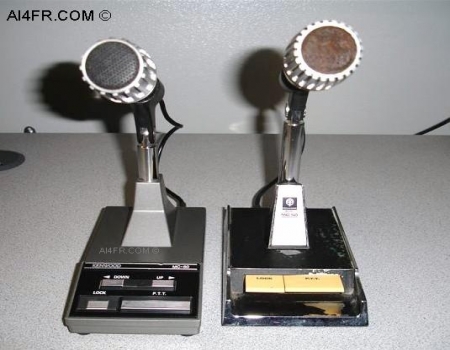
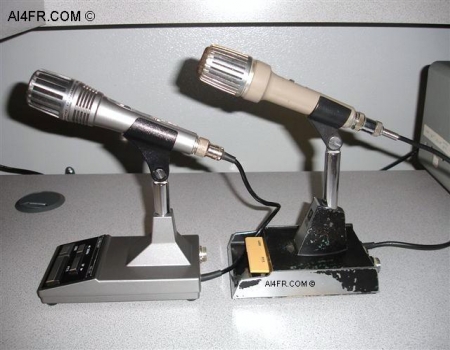
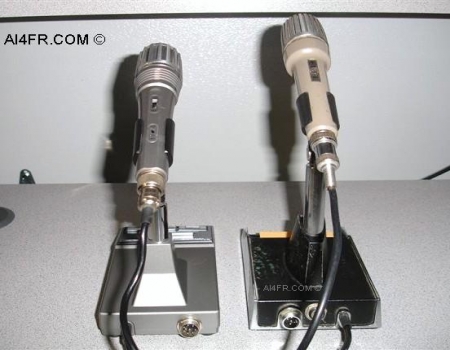
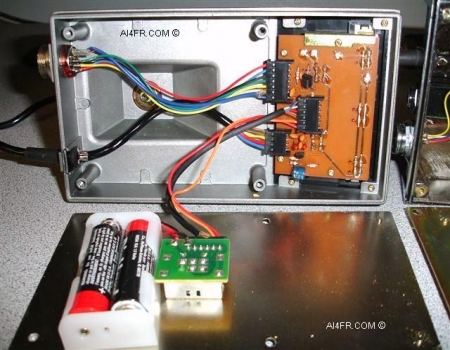
The Kenwood MC-50 and MC-60A has been a popular desk microphone among Kenwood owners for many years. They both have a communication type dynamic and unidirectional moving coil microphone element. The MC-60A employs a "feather-touch" switch design on the base, while the MC-50 incorporates a piano key style of switches on the base. Both microphone designs have a PTT (push to talk) switch as well as a lock feature for extended transmissions. Both microphones also have a PTT lock switch on the microphone body. The MC-60A has an added rocker switch on the top of the base for the UP and DOWN tuning of compatible Kenwood transceivers. The microphone impedance may be set for 50K ohms or 500 ohms on the MC-60A, and 50K ohms or 600 ohms on the MC-50. To select the different impedance settings on the MC-60A, all one has to do is flip a switch on the top of the microphone body. The procedure differs some what on the MC-50 in that the operator of that style of microphone will need to unplug the microphone cord at the base and turn it 180 degrees. Most of the Kenwood HF products are 50K ohms, while all of their mobile VHF and UHF radios have a 500 ohm impedance. Some of the Kenwood HF radios can operate from either of the two impedances. Either way, Kenwood recommends that the operator speak at a minimum distance of four inches away from the microphone. The frequency response is 150 Hz to 10 kHz (-6dB) on both microphones. The MC-60A has an added preamp and when this item is engaged, the frequency response is 200 Hz to 7 kHz (-6 dB). The preamp requires two AA cells which are mounted on the inside bottom of the base. The MC-50 does not have a preamp. Each design incorporates a heavy zinc die-cast base which provides for extra stability. This page was originally planned to showcase just a single MC-60A microphone from those that I had laying around, but then I thought that since I also had an MC-50, why not put the two together for a side by side comparison. In both of the photographs above, the MC-60A microphone is on the left. In the photograph on the right the black paint on the base of the MC-50 has started to wear thin from the many years of use. Important note: Kenwood also manufactured an MC-60 microphone without any letter suffix. This microphone is essentially the same as the MC-60A except that it does not have the preamp circuitry and the associated components. Every MC-60A microphone that I have ever owned has been marked MC-60. |